 Home
Home  Contact
 The INSARAG Medical Working Group (MWG) in keeping with UN General Assembly Resolution 57/150 on “Strengthening the Effectiveness and Coordination of International Urban Search and Rescue Assistance” aims to enhance the INSARAG Guidelines that will enable the medical component of a USAR team and develop relevant medical guidance notes.
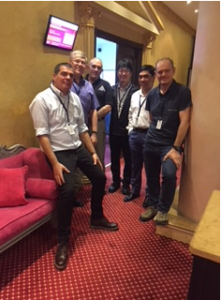
MWG was established in 2008 with the endorsement from the INSARAG Steering Committee in 2007. This inter-regional working group aims to focus on the medical requirements of international USAR teams being deployed outside their countries of origin. The group meets two to three times a year. The reports of this working group’s meetings can be found below. The medical guidance notes prepared by this working group and endorsed by the INSARAG Steering Group can be found in the ‘Methodology’ tab.
Terms of Reference
2023:
Chairman`s Summary – AAR and AEME Regional Meeting 2023 Qatar
Chairman’s Summary – Team Leaders Meeting 2023 Singapore
Participant List – Team Leaders Meeting 2023 Singapore

Current LTQAWG membership:
| Brad Commens | Australia | Asia-Pacific | Co-Chair | Brad.Commens@qfes.qld.gov.au |
| Rob Davis | UK | AEME | Co-Chair | rob.davis@saraid.org.uk |
| Christophe Debray | France | AEME | Member | cdebray55@yahoo.com |
| Johannes Gust | Germany | AEME | Member | j.gust@at-fire.de |
| Cem Behar | Turkey | AEME | Member | cembehar@gmail.com |
2022 Update
The first Light USAR IEC was completed during the INSIEME Exercise in Switzerland from 21-24 November 2021. This exercise had previously bee delayed by 18 months due to the COVID-19 Pandemic, and was conducted in the colder months, providing additional challenges for all teams. Following the successful exercise a review of the IEC was conducted by the LTQAWG via VidCon on 20 December 2021 after the IEC report was released.
A Review of Light USAR Team Classification – @fire November 2021 was prepared to review the Process, Observations and Recommendations from the Light IEC, and was provided to the INSARAG Secretariat on 28 January 2022. A follow up meeting was held in conjunction with the Team Leader’s meeting in Qatar on 7&8 March 2022, confirming that:
- The Light USAR IEC process has been developed and proven in practice.
- A review of the Light IEC process has been completed
- No changes to the Checklist are currently recommended
- Further improvements to the concept are expected in the future for flexibility as required by INSARAG.
- Classified Light Teams will provide more Classifiers to the global pool.
- Light USAR team concept is progressing for recognition by the EU Civil Protection Mechanism (ECPM) in 2022. RE: Council Decision No. 1313/2013/EU
- Three Light USAR Teams are progressing to IEC in 2022
Recommendations were tabled during the Team Leaders meeting for the LTQAWG to transition to a reference group (Light Team Quality Assurance Reference Group – LTQARG), to provide technical and concept advice to Teams, Mentors and Classifiers involved in future Light USAR IEC/R activities, until the concept is universally accepted and understood throughout the network. This recommendation was approved by the INSARAG Steering Group (ISG) during the HNPW meeting on 10 May 2022, transitioning the group to LTQARG.
Three Light USAR IEC’s are planned for 2022 for teams; GEA-Turkey; SARAID – United Kingdom; and Cyprus. The LTQARG update information from the 2022 ISG are here.
Review of Light Team Classification – @fire November 2021
Workplans:
2021-2022
A LTQAWG meeting was conducted in conjunction with the @fire pre-exercise brief on 28 September 2021 (Slide brief provided). This meeting provided an overview of the Light USAR concept and considerations for the upcoming IEC (@fire).
The key discussion points during the virtual meeting included the overview of a light team IEC, and the focus on achieving the required assessment items in a reduced timeframe, as a result of only two work periods instead of the standard three periods for a continuous 24 hour exercise.
In November 2021, the first classification of a Light USAR team (@fire) to INSARAG IEC standards was completed as part of the INSIEME excercise, in Geneva.
Following the Light USAR IEC, a review of the process will be conducted by the LTQAWG members to highlight any areas of amendment required to progress the Light IEC process for future benefit.
This review will require the disclosure of the Light IEC report by the @fire team to assist with the analysis of the effective classification process.
A final LTQAWG meeting is planned fot the Working Group/Team Leader meeting in Qatar in March 2022, at which time a decision on the future of the LTQAWG will be agreed.
October 2019 Team Leaders Meeting Chile
INSARAG Light team Working Group Chairman Summary
Attached, the Classified Light Usar Team Position
Completed work of the LTWG:
The document “Introduction LT” describes the concept of International Light Teams. At this moment the Guidelines text for the GRG has been assembled and rewritten on the Light concept and needs a final check to see if it is complete. The results will be shared with you before the coming summer holidays.
The document “Quality Assurance explanations” describes the advice of the LTWG to the new QAWG. A PowerPoint presentation is added to clarify the text and to show how a classification process could be setup for International Light. And at the same time could be used for a discussion about the classification process for Medium and Heavy in the future in the attempt to reduce the amount of work to assure the existing quality.
The document “USAR scale” explains the differences between national, regional and international deployment of USAR teams and the need for the type of quality assurance. The LTWG thinks that this document will clarify the inter-linkage between International Light teams and existing systems National-, Neighbour assistance- and classified International Medium and Heavy teams. A PowerPoint “National Regional and International assistance scale” is added to show the build-up of a large scale incident.
The document “LTWG Meeting Chairman summary Valabre” is a reflection of the work of the LTWG during the final meeting in France in April 2017.
2018
- Designing the classification process for Light Teams and preparing the documentation for the implementation of international light teams in the system
At the INSARAG Steering Group Meeting (ISG) in 2016, the group directed the Secretariat to initiate the establishment of an INSARAG Light Teams Working Group (LTWG) with clear terms of reference and to request INSARAG regional groups to nominate suitable members. Relevant members from existing working groups could be co-opted. The LTWG will take the lead and, following consultations with the regional groups in 2016, present the recommendations to the ISG of 2017 for a decision.
The LTWG is made up of representatives coming from the three INSARAG Regional Groups, and are selected from different USAR Teams Heavy, Medium and non-classified teams selected by the Secretariat. The LTWG is chaired by Arjan Stam, Team leader from the Dutch USAR team, chair of the UCC in the earthquake of Nepal, IEC/IER Team leader and the member of the GRG.
The first meeting of the LTWG was held in Geneva from 15-17 June 2016 and was also attended by the Chair of the TWG Mr Dewey Perks.
Chairman’s Summary – First LTWG Meeting 15-17 June 2016
Proposal External support and Validation process National Accreditation_ENG
The INSARAG Information Management Working Group (IMWG) was established to strengthen information management, including the INSARAG Coordination and Management System (ICMS), across the INSARAG network, supporting more effective coordination and decision-making in Urban Search and Rescue (USAR) operations.

Announcements
The IMWG is looking for additional technical support to augment the development and operation of ICMS. Please refer to the Technical-Support-IMWG-Requirements for the three main development roles.
Please indicate your interest to imwg@gmail.com and Jeff.maunder@fireanemergency.nz
Documents from the working Group
ICMS 3.0 Work plan (Draft) Download
2024-2029 IMWG CONOPS Download
IMWG Presentation TLM Brazil 2024 Download
Call for funding support of the INSARAG Coordination and Management System (ICMS)

- The INSARAG Africa, Europe and Middle East (AEME) regional group meeting took place last week from 17-18 October in Aix en Provence, generously hosted by the Government of France and the Disaster and Emergency Management Authority (Direction Générale de la Sécurité Civile et de la Gestion des Crises, DGSCGC). The meeting which brought together 67 participants from the region and beyond representing 28 countries and 2 organizations aimed at electing a Regional Troika 2019, finalizing the INSARAG AEME Regional Plan for 2019, discussing the key INSARAG issues following the 2018 INSARAG Steering Group meeting, namely: Changed in the classification system/ new IER checklist, Light Teams Quality Assurance Standards, National Accreditation Processes, INSARAG Global Meeting 2020, and INSARAG Guidelines feedback.
- INSARAG Regional Meetings are a gathering of international USAR policy makers, team leaders, and governmental representatives, to exchange information about technical and political USAR issues in the INSARAG context.
- Presentations included one delivered by the EU-European Emergency Response Capacity, the INSARAG Earthquake exercise in Armenia and the National Accreditation process done in the Americas’ region.

The list of approved members for the GRG from 2018 to 2020
Co-Chair of GRG, Mr. David Sochor and Mr. Anwar Abdullah
| Name | Country | Position | Email address |
| David Sochor | Switzerland | Co-Chair | david.sochor@eda.admin.ch |
| Anwar Abdullah | Singapore | Co-Chair | Anwar_abdullah@scdf.gov.sg |
| Annika Coll | Spain | Member | annika.coll@madrid.org |
| Sebastian Mocarquer | Chile | Member | smocarquer@gmail.com |
| Silvia Ballen | Colombia | Member | silvia.ballen@gestiondelriesgo.gov.co |
| Johnny Ramírez Zumbado | Costa Rica | Member | j.rz1975@hotmail.com |
| David Lewis | Australia | Member | David.Lewis@fire.nsw.gov.au |
| Paul Burns | New Zealand | Member | Paul.Burns@fireandemergency.nz |
| Chen Hong | China | Member | chenhongicd@163.com |
| Mohammed Alshahrani | Saudi | Member | engmohd404@gmail.com |
| Firas Falah Abu Al Sondos | Jordan | Member | Disa_dpt@cdd.gov.jo; firascdd@yahoo.com; |
| Samghouli Soufian | Morocco | Member | Soufian104@yahoo.fr |
| Belit Tasdemir | Turkey | Member | belittasdemir@akut.org.tr |
| Martin Evers | Netherlands | Member | martin.evers@vrh.nl |
| Vasily Evseev | Russia | Member | dmd.mchs@yandex.ru; timer84@gmail.com |
2020
The 7th GRG meeting took place from 3 to 5 February in Geneva
Annex A – Feedback on INSARAG Guidelines 2020
Annex B – Shifting of Selected Annexes, Forms and Checklists
Annex C – Updates to INSARAG.org (INSARAG Guidelines, TRL, Guidance Notes
Salient Pointers: Co-Chairmanship Working Model – GRG 2020
GRG 2020_ Co-Chair Write-up document
2019
The 6th GRG Meeting took place from 9 to 11 December 2019 in The Hague, Netherlands
Coverning Note on TRL and Guidance Notes
Annex C _ TRL Navigation Overview
::::::::::::::::::::::::::::::::::::::::::::::::::::::::::::::::::::::::::::::::::::::::::::::::::::::::::::
The 5th GRG Meeting took place from 6 to 8 October 2019 in Santiago de Chile, Chile
GRG Anney A proposal for coour coding system
Key Takeaways for GRG TWG Meeting
:::::::::::::::::::::::::::::::::::::::::::::::::::::::::::::::::::::::::::::::::::::::::::::::::::::::::::::
Final version of the 3rd GRG Meeting Chairman Summary which took place from 4 to 8 February in Geneva during the Humanitarian Network Partnership Week (HNPW)
3rd GRG Meeting Chairman Summary
4th Meeting of GRG, 12-14 June 2019, Singapore
The INSARAG Guidelines Review Group(GRG) Meeting hosted by the Co-Chair, Singapore, is taking place this week with 15 expert participants from 11 countries representing the Americas, Africa, Europe, the Middle-East, and the Asia-Pacific regional groups. The INSARAG Steering Group as directed the GRG to conduct the 5 yearly extensive review and consultations with the global network for a version 2020-25, and to be launched at the 30th Anniversary of INSARAG in Warsaw, Poland in October 2020.
The INSARAG Guidelines are the cornerstone of the globally accepted global standards as endorsed by UN GA 57/150 of 16 December 2002 and guides member countries on urban seach and rescue(USAR) preparedness and response arrangements.


2018
The GRG 2020 also apprised the TLs on the overall plan and current status of work.
In the breakout session, the GRG 2020 will engage the TLs on the matter of the Technical Guidance Reference Library/Best Practice. Regular engagement and close coordination with the INSARAG Working Groups is imperative to the achievement of the objective of a comprehensive reviewed Guidelines. The outcome of this engagement will be captured in the chairman’s summary and be shared with the INSARAG Network.
The XVI Meeting of the INSARAG Americas Regional Group as well as the IV Consultation meeting on the emergency response cooperation mechanism of the United Nations Disaster Assessment and Coordination (UNDAC) team, were held in Guayaquil, Ecuador from 29 November to 1 December 2017.
The meeting was hosted by the Secretariat of Risk Management of Ecuador and co-organised by the United Nations Office for the Coordination of Humanitarian Affairs (OCHA) in its capacity as INSARAG Secretariat and UNDAC system manager.
A total of 44 participants from 21 countries and OCHA participated it the meeting.
The chairman summary, with its annexes, including the list of participants, can be found below.